
If you have asked three agencies this question, you have probably received three very different answers — one week, one month, three months. All of them can be honest. The timeline depends almost entirely on what you are building and how quickly you can supply what the designer needs.
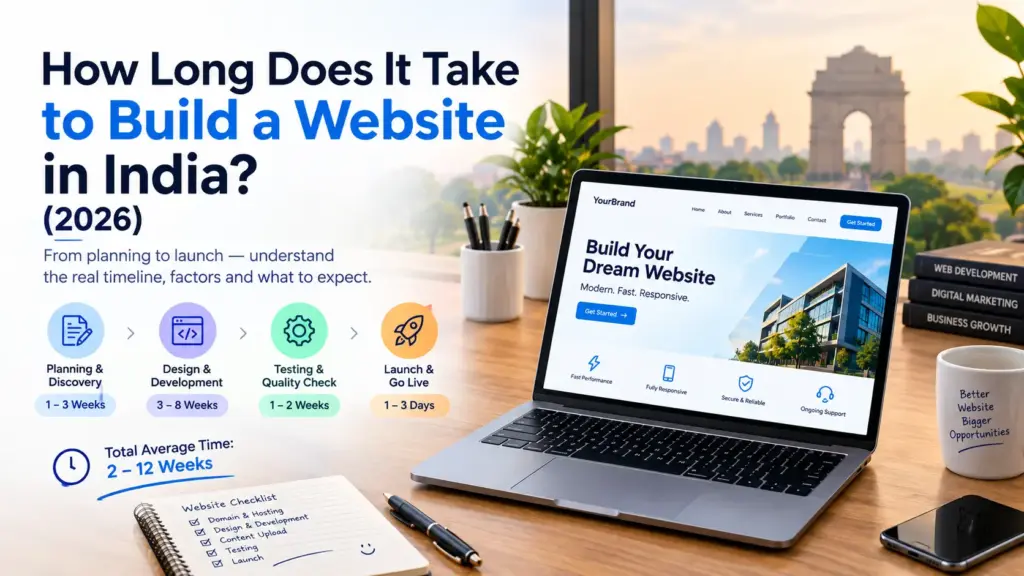
This guide gives you realistic timelines for each type of website, a breakdown of what happens in every stage, and the honest reasons projects run late in India. By the end you will be able to judge whether a quoted timeline is reasonable or wishful thinking.
The short answer
For most small businesses in India, a professional website takes two to four weeks from kickoff to launch. Here is how that varies by project type:
| Type of website | What it includes | Realistic time |
|---|---|---|
| Landing page | Single page, one clear call to action | 3–7 days |
| Small business site | 5–8 pages, contact form, mobile responsive | 2–3 weeks |
| Business site with blog | 10–15 pages, blog, custom design | 4–6 weeks |
| E-commerce store | Up to 100 products, payment gateway, shipping | 5–8 weeks |
| Custom web application | Login systems, dashboards, integrations | 3 months+ |
These are working timelines, not calendar timelines. A three-week project can easily stretch to six weeks if feedback takes a week to arrive each time.
What actually happens, stage by stage
Most website projects move through six stages. Knowing what each one involves helps you spot where your own project might slow down.
Stage 1 — Planning and requirements (2–4 days)
The designer needs to understand your business, your customers, and what the website is supposed to achieve. This stage decides your page structure, the features you need, and what content will go where. Projects that skip this stage almost always take longer overall, because decisions get made twice.
Stage 2 — Design (4–7 days)
You see the homepage layout first, approve the visual direction, then the remaining pages follow the same style. If you are using a well-built template, this stage is much shorter. A fully custom design adds one to two weeks.
Stage 3 — Content (this is the one everyone underestimates)
Text for every page, product photographs, your logo in a usable format, team photos, testimonials. On paper this takes two to three days. In practice it is the single biggest cause of delay in Indian web projects, because business owners try to write it between customer calls.
If you can hand over finished content on day one, you can realistically cut a week off your project.
Stage 4 — Development (5–10 days)
The approved design gets built into a working website: responsive layouts for mobile and tablet, contact forms, WhatsApp integration, Google Maps, payment gateway if you need one. Speed optimisation happens here too, not afterwards.
Stage 5 — Testing (2–3 days)
Every form gets submitted, every link clicked, and the site gets checked on real devices — not just a desktop browser window made narrow. In India this matters more than in most markets, because the large majority of your visitors will arrive on a mid-range Android phone, often on a patchy connection.
Stage 6 — Launch and handover (1–2 days)
Domain connection, SSL certificate, Google Search Console and Analytics setup, and a walkthrough so you can update your own content. Add up to 48 hours for DNS changes to propagate fully — this is not the developer being slow, it is simply how the internet updates domain records.
Why projects actually run late
In our experience, delays are rarely caused by the development work itself. Four things account for most of them.
Content that never arrives
The design is finished, the developer is ready, and the project sits idle waiting for an About Us paragraph and six product photos. Write your content before the project starts, or agree upfront that the agency will write it for you.
Feedback that arrives in pieces
Three separate WhatsApp messages over five days, each with one small change, costs far more time than one consolidated list. Collect all your feedback, review it with whoever else needs to approve it, then send it once.
Scope creep
A blog added in week two. A booking system in week three. Each addition is reasonable on its own, but every one of them resets part of the design and testing work. Decide your feature list before design begins, and keep a separate list for phase two.
Domain and hosting access
If your domain was registered years ago by a cousin or a previous agency, tracking down the login can take longer than building the website. Find those credentials during week one, not on launch day.
The developer is rarely the bottleneck. Content, feedback and access almost always are.
Does a cheaper website take longer?
Usually the opposite. Budget-friendly websites are built on proven templates and established frameworks, so the design stage is dramatically shorter — the structure is already tested and only needs to be adapted to your business. That is why a well-run low cost website design project often goes live in a week or two, while a fully custom build takes a month or more.
What a lower budget genuinely changes is the amount of custom work, not the quality of the result. A template-based site can still be fast, mobile responsive and properly optimised for search. You can compare what is included at each level in our website design packages.
Be cautious of anyone promising a complete e-commerce store in 48 hours. That timeline is only possible by skipping testing, optimisation or content and you will pay for it later in lost customers.
How to get your website live faster
- Write your content first. Even rough text is better than nothing. The designer can refine it, but cannot invent your service descriptions.
- Gather your assets in one folder. Logo, photographs, certificates, testimonials, existing brochures.
- Locate your domain and hosting logins before the project starts.
- Name one decision maker. Design by committee doubles every review cycle.
- Consolidate your feedback into a single numbered list per round.
- Park the extras. Launch with what you need, add the rest in phase two.
Businesses that do these six things routinely launch in half the time of those that do not — with the same designer and the same budget.
Frequently asked questions
Can a website be built in one day?
A single landing page can be, provided the content is ready and you accept a template with minimal changes. A multi-page business website cannot be built properly in a day, whatever the advertisement claims.
How long does an e-commerce website take in India?
Five to eight weeks for a store with up to 100 products. Payment gateway verification alone can take three to five working days, since the provider must verify your business documents before going live.
Why do some agencies quote three months?
Usually because the project is genuinely custom, or because the agency is managing many clients at once and is quoting calendar time rather than working time. Ask specifically how many working days of effort your project requires.
How long before my website appears on Google?
Indexing takes a few days to two weeks after launch. Ranking for competitive search terms takes considerably longer — typically three to six months of consistent SEO work. Launching the website is the start of that process, not the end of it.
Can I add pages after the website is live?
Yes. A well-built WordPress website lets you add pages, blog posts and products yourself. Ask for a short handover walkthrough at launch so you are not dependent on the agency for routine updates.
Ready to start?
Most small business websites take two to three weeks when the content is ready and feedback is prompt. If you would like a realistic timeline for your specific project, get in touch and we will map out the stages before you commit to anything.